In Climate Policy Ambition: Exploring A Policy Density Perspective, we measure climate policy density from 2000-2019 by drawing on three publicly available databases: Climate Change Laws of the World, Climate Policy Database and the Policies and Measures Database. All three measurements show an upward trend in the adoption of climate policy. However, our empirical comparison also reveals differences between the measurements with regard to the degree of policy expansion and sectoral coverage, which are due to differences in the type of policies in the databases. Since the choice of the database and the resulting measurement of policy density ultimately depend on the questions posed by researchers, we conclude by discussing whether some questions are better answered by some measurements than others.
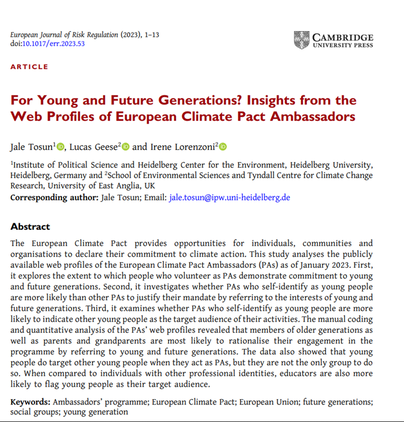
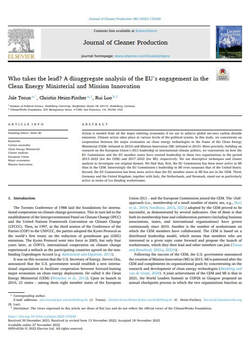
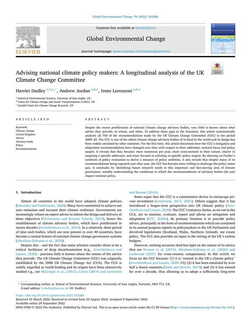
A number of papers by DeepDCarb team members have recently been published.
'The political challenges of deep decarbonisation: Towards a more integrated agenda'' appears in the inaugural issue of the newly launched Climate Action journal. As the societal commitment to deep decarbonisation will eventually emerge from the interaction between policies, publics and politicians, in this paper we review the existing literatures on these three to identify salient research gaps. Our findings show that existing work has largely focused on one aspect in isolation. Thus, we set out a more integrated research agenda that explores the three-way interaction these, arguing that greater integration is required to understand better the conditions under which different political systems address societal commitment dilemmas. A contribution co-authored by Dr Irene Lorenzoni is featured in the 30th anniversary issue of Global Environmental Change. Progress in understanding and overcoming barriers to public engagement with climate change is one of ten invited commentaries from authors among the highest cited papers from the journal over the period 2001-2019. It follows up on the 2007 publication Barriers perceived to engaging with climate change among the UK public and their policy implications and the new commentary reflects on research published over the past decade and a half on engagement with climate change, from diverse disciplines and perspectives.
In our update last month, we announced details of recent DeepDCarb publications, including Transformations for climate change mitigation: A systematic review of terminology, concepts, and characteristics. Brendan Moore has recently written a blog post outlining the key findings from this paper, and this can be accessed here.
This month, two new peer-reviewed papers were published from the DeepDCarb project.
The first of these 'The Challenging Paths to Net-Zero Emissions: Insights from the Monitoring of National Policy Mixes' features in a special issue of The International Spectator focusing on Europe’s transition to sustainability. Examining data from the last 10 years that member states have reported to the EU on the climate policies that they have or will put in place to achieve collectively agreed EU targets, the analysis reveals that the average expected per-policy-instrument emission reduction has declined, while national policy mixes have remained generally stable over time. |
AuthorJ Kenny Archives
July 2024
Categories |

 RSS Feed