|
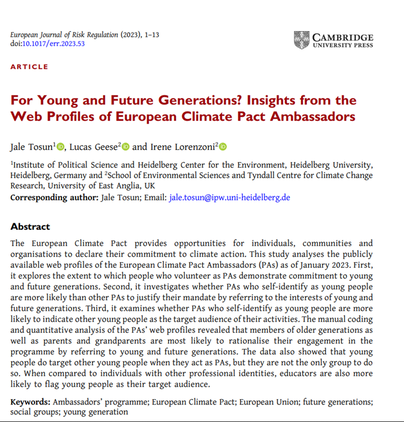
As an outcome of the European Green Deal, European Climate Pact Ambassadors (ECPAs) were established to promote climate action within their networks at both a local and an EU level. This book focuses on the volunteers who commit to the role of ECPA, and unpacks who steps up, how they advocate for policy change, and what they experience along the way. Bridging political sociology, policy analysis, and multi-level governance, the book offers a rare insight into EU-level civic participation.
Open access will be available soon: https://bristoluniversitypress.co.uk/european-climate-pact-ambassadors.
0 Comments
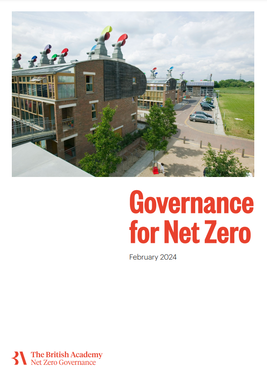
On 15 September, the British Academy formally launched a major new report on Governance to Accelerate Net Zero. Advised by a panel of Fellows including Andy Jordan, Tim O’Riordan and Hilary Graham (CAST), the report was more than three years in the making and drew on an extensive array of stakeholder events. At the launch event, two panels of experts (which included Lorraine Whitmarsh and Nick Pidgeon) and the Chief Scientific Advisor of the climate change ministry DESNZ (Prof Paul Monks), reacted to the 5 main recommendations. To access the report and all the supporting evidence visit the BA Net Zero Governance hub: Net Zero Governance | The British Academy. Throughout 2025-6, the BA will engage in a programme of translation work involving researchers and policymakers across all levels of government. Net zero is a complex, systemic challenge. It demands good democratic governance to drive collective action across regions, sectors and communities.
A major British Academy review involving Andy Jordan analyses relevant evidence and insights from the SHAPE disciplines (Social Science, Humanities and the Arts for People, Economy & environment). The findings, presented in this report, show a striking consensus: collaborative leadership across levels of government, place-led initiatives in partnership with intermediaries and a more people-centred approach to participation and net zero action are central to reaching net zero at speed. This will mean action from each level of government in each part of the UK. While governance frictions can lead to inertia, this report argues that leaders can use the evidence, case studies and insights from researchers, practitioners and policymakers to instigate multi-level, multi-actor, multi-directional solutions that will accelerate climate action. The report contains many case studies of good practice from across many levels of government in the UK, from Aberdeen to Hackney, to draw out practical lessons for the journey ahead. Net Zero Governance | The British Academy National Citizen’s Climate Assemblies (NCCAs) been held in many European countries over the past decade. They have been commended by deliberative theorists and practitioners as a means to address the perceived inability of current democratic systems to deal effectively with climate change. Yet it is only recently that such claims have been explored empirically.
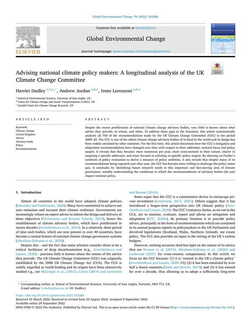
Climate advisory bodies have been established in over 40 countries. However, the existing literature focuses on their formation and remits, not their unfolding policy impact. A new article in Climate Policy - 'The policy impact of climate change advisory bodies: government responses to the UK Climate Change Committee’s recommendations, 2009–2020' - addresses this important gap by reporting the findings of a novel analysis of the UK Government’s responses to the UK Climate Change Committee’s (CCC) mitigation and adaptation recommendations published in its annual progress reports, taking written acceptance as a proxy for policy impact.
Earlier this year, the Journal of Comparative Policy Analysis published a special issue 'Climate Action through Policy Expansion and/or Dismantling: Country-Comparative Insights' which arose out of a workshop DeepDCarb hosted in Mannheim in 2022. In the video below, Simon Schaub - the lead guest editor - shares the main findings of the issue. The current issue of WIREs Climate Change contains our systematic review titled 'Politicians and climate change: A systematic review of the literature'. Covering 141 articles, we find a growing research area that is primarily focused on a small number of democracies in the Global North. Substantively, we analyse politicians' motivations, the incentives and barriers they face, and the strategies they employ to block/enable climate action. A briefing note outlining some key themes from the review is also available here.
|
AuthorI Lorenzoni Archives
November 2025
Categories
All
|
RSS Feed